§ Catalog
Thirty paintings.
The full catalog: thirty entries in chronological order, every one a painting whose primary subject is, or whose composition turns on, a dog. Each is given artist, title, year, medium, collection of record, and a short editorial note.
By period All 30 Renaissance 04Sporting Age 05Victorian 13Modernist 08
Cat. 02 / 30 · Renaissance
Titian
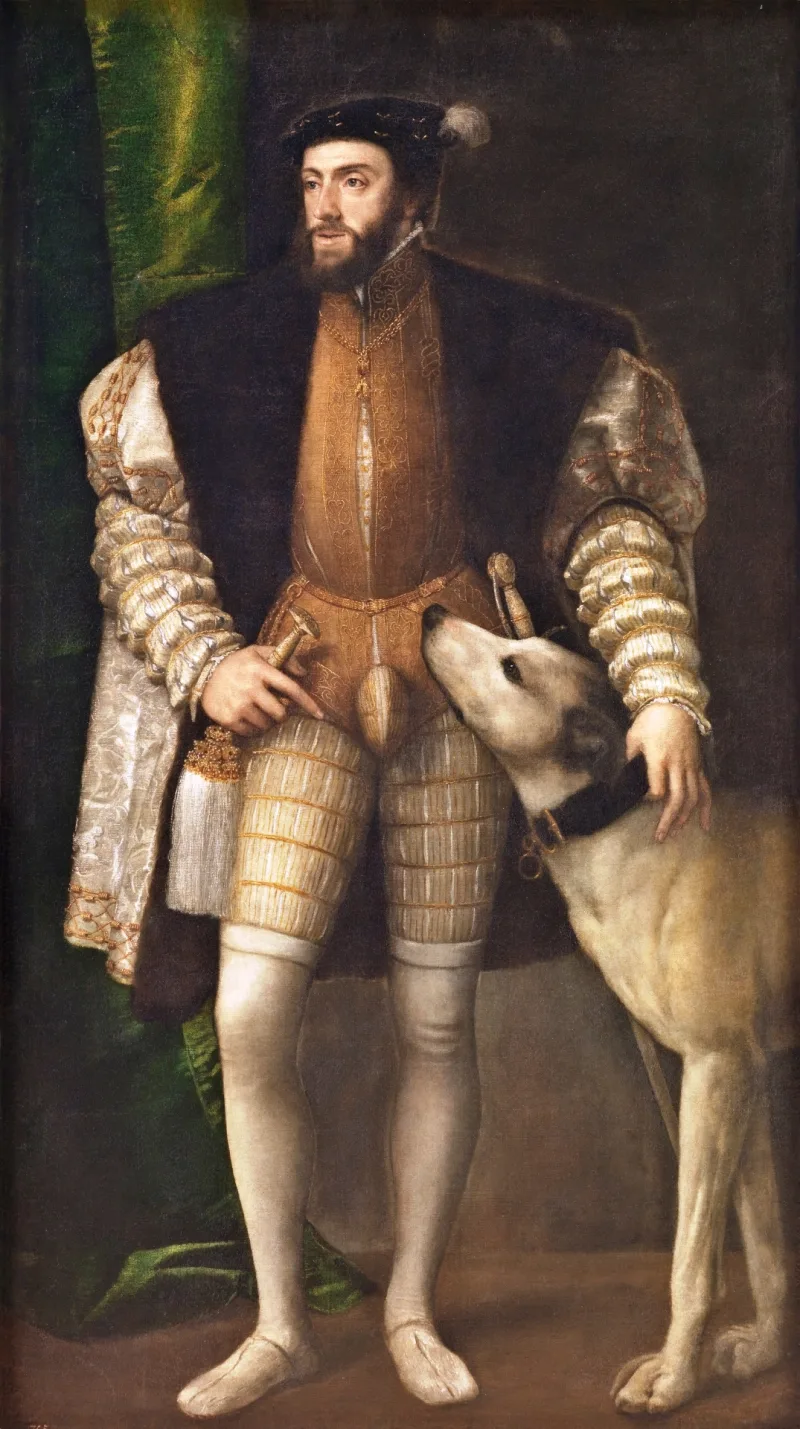
Charles V with a Dog
A standing full-length portrait of the Holy Roman Emperor with a large hound at his side — the dog's head reaching nearly to the emperor's hand, its body weight given the same compositional gravity as the figure's.
Titian's sitter required the dog as much as the dog required Titian: the animal serves both as a marker of dynastic authority and as a structural anchor that breaks the long vertical of the imperial figure into something the eye can read.
Reproductions Find a print →
Cat. 03 / 30 · Renaissance
Paolo Veronese
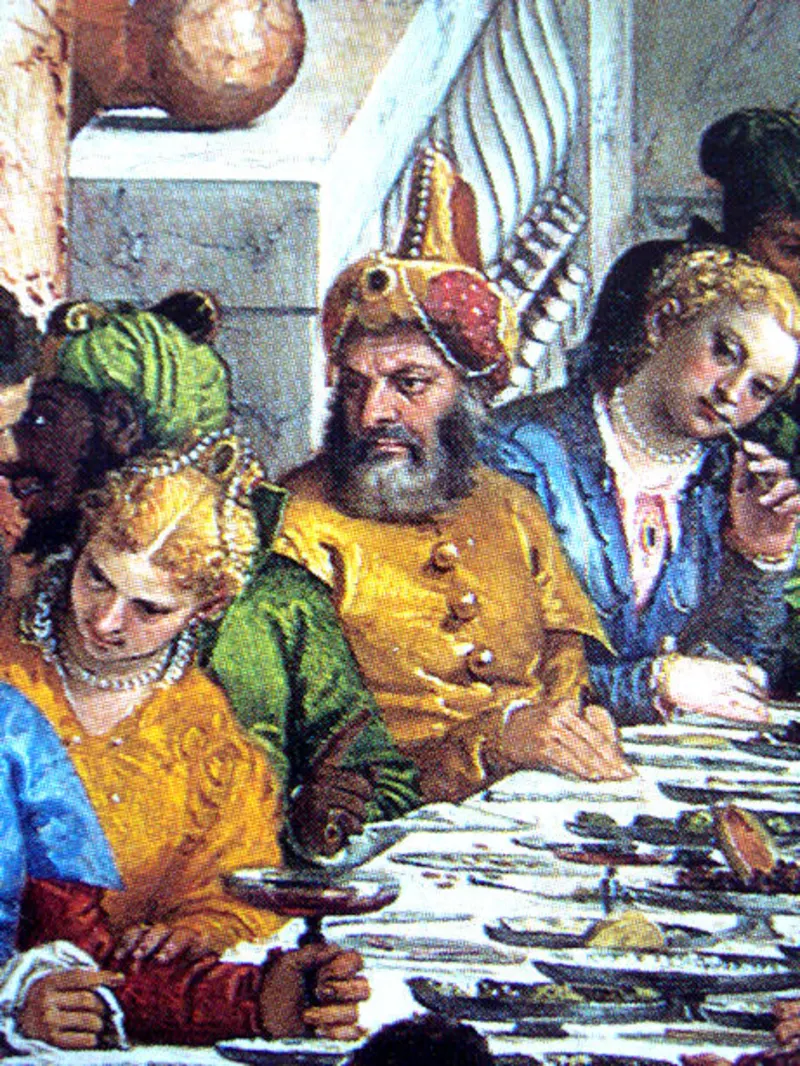
The Wedding at Cana (detail)
Two dogs appear in Veronese's vast banqueting scene: a white hunting dog at the lower-left edge of the table, and a second hound watching from the bridge of the architectural setting. Neither is incidental.
The painter, called before the Inquisition to defend the inclusion of dogs and other "vulgar" details in a sacred subject, replied that painters take "the same liberty as poets and madmen." The dog stays in the picture, and stays in the canon.
Reproductions Find a print →
Cat. 04 / 30 · Renaissance
Diego Velázquez
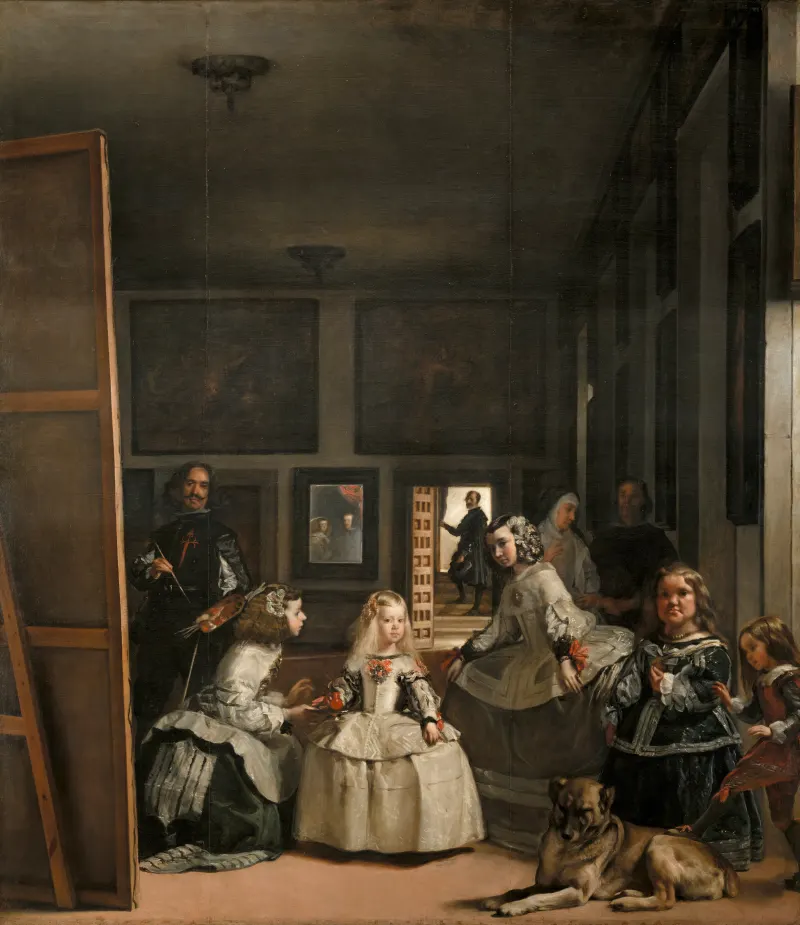
Las Meninas
The mastiff in the lower-right foreground of Velázquez's court portrait is the painting's anchor of weight — a sleeping animal whose mass holds the bottom of the composition while the human figures distribute themselves at the top.
A small boy rests his foot on the dog's back. The dog does not stir. It is one of the most fully painted dogs in Western art: every brushstroke serves the impression of a heavy body breathing slowly.
Reproductions Find a print →

Cat. 05 / 30 · Sporting Age
William Hogarth
The Painter and His Pug
Hogarth places his pug Trump on a wooden ledge below his own self-portrait. Painter and dog occupy the same plane and the same painted air — a pairing that reads, even now, as the picture of a household.
The dog's likeness is no afterthought. The folds at the muzzle, the watery eye, the slight lean toward the canvas all suggest a painter who knew this animal as well as he knew his own face.
Reproductions Find a print →
Cat. 06 / 30 · Sporting Age
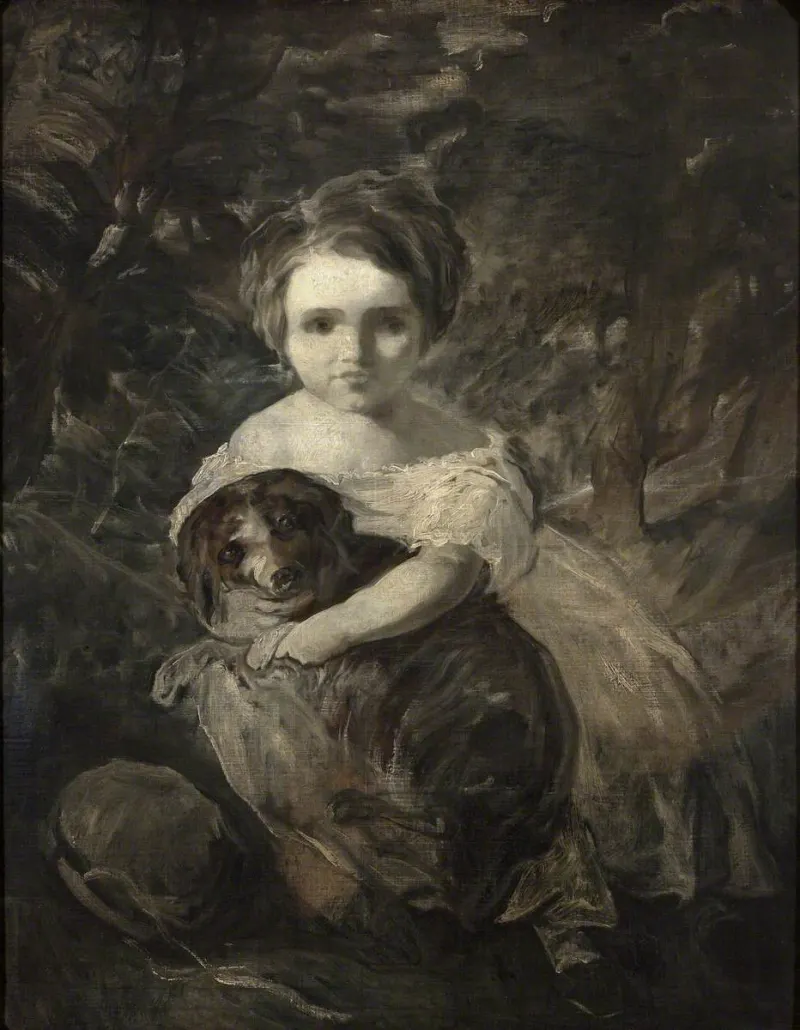
Sir Joshua Reynolds
Miss Jane Bowles
Reynolds paints the four-year-old Jane Bowles with a spaniel half her size held in her lap. The dog's body curls into the child's arms; both look out of the painting toward something the painter has placed off-canvas.
It is among the most quoted childhood portraits in the Reynolds catalog precisely because the dog is not staged but borne — the child carries it the way one carries something living and warm.
Reproductions Find a print →
Cat. 07 / 30 · Sporting Age
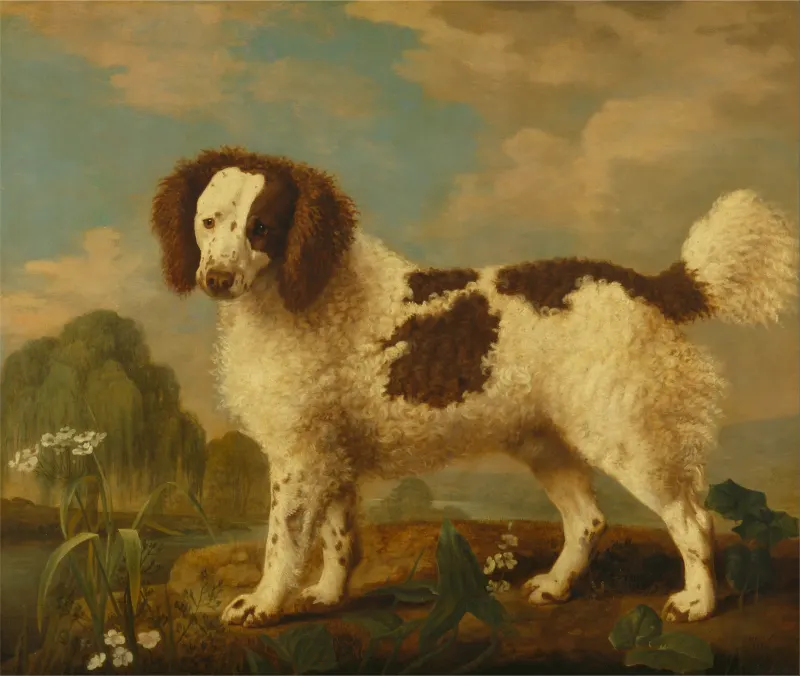
George Stubbs
A Brown and White Norfolk or Water Spaniel
A working spaniel painted at full studio size, set against a landscape that the painter has thinned to nearly a backdrop. The dog's wet coat is the picture's subject; everything else is context.
Stubbs brings the anatomical exactness of his racehorse portraits to a single working dog. The leg articulation, the depth at the chest, the way the spaniel's gaze answers the painter's — all rendered with the precision of a clinician.
Reproductions Find a print →
Read the full George Stubbs biography 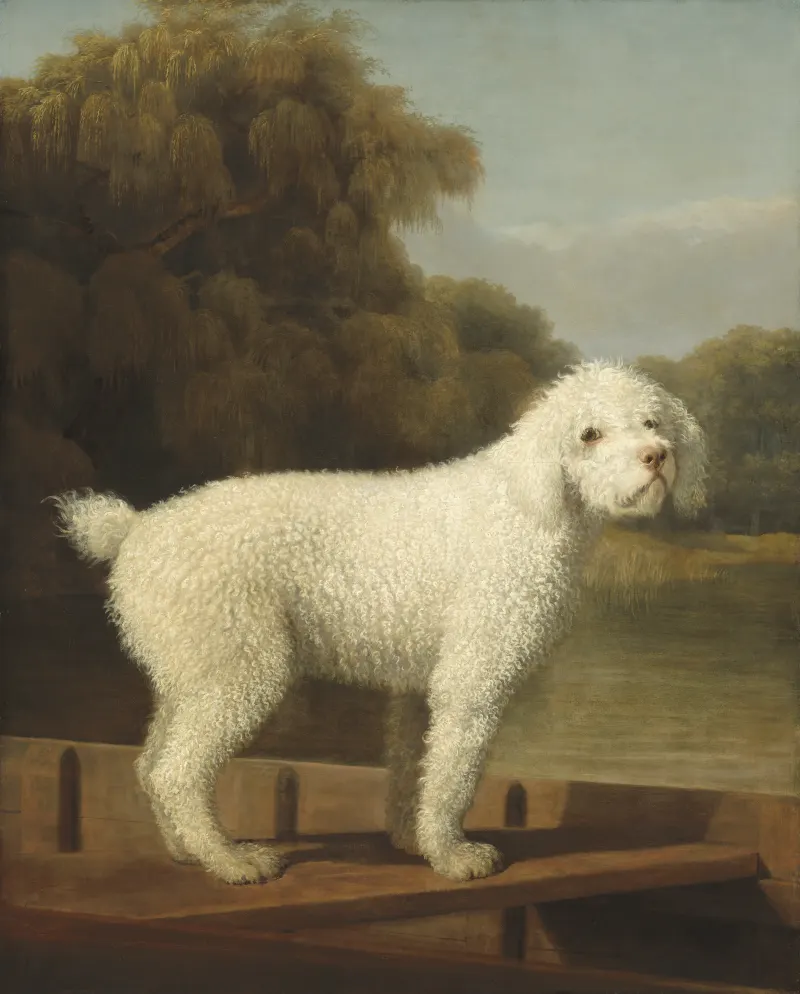
Cat. 08 / 30 · Sporting Age
George Stubbs
White Poodle in a Punt
A small white poodle stands in the middle of a flat-bottomed boat, head raised, the river's far bank passing behind it. The animal is the only living figure in the composition.
Stubbs grants the poodle the dignity he routinely granted his racehorse sitters: a still, frontal presentation against a plain horizon. The picture rests, against all genre convention, on the calm of a single small dog.
Reproductions Find a print →
Read the full George Stubbs biography 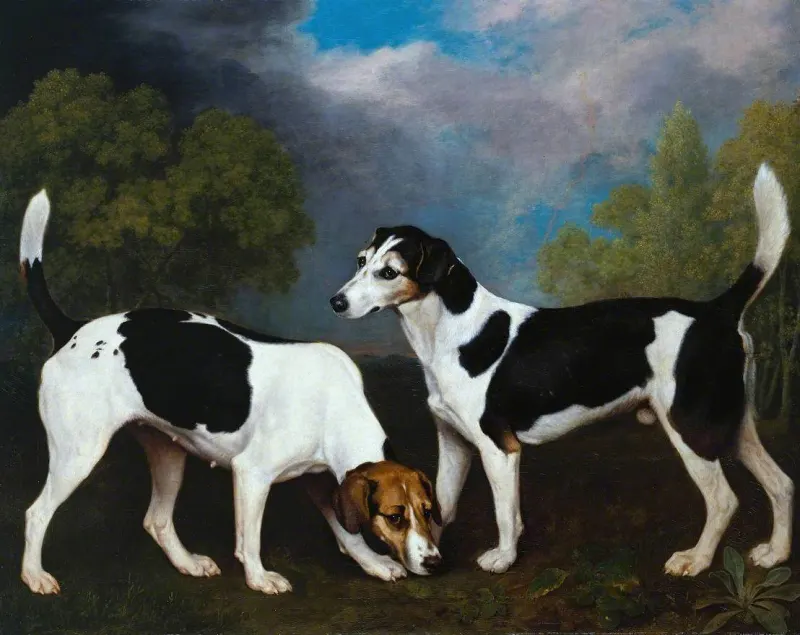
Cat. 09 / 30 · Sporting Age
George Stubbs
A Couple of Foxhounds
Two foxhounds, painted at near life size, set against a low English horizon. The pair stands rather than runs; the picture is a study of working anatomy at rest.
It is one of the cleanest examples of Stubbs's late style: nothing of incident, nothing of narrative, only the careful description of two dogs taken seriously enough to deserve the same canvas a duke might.
Reproductions Find a print →
Read the full George Stubbs biography 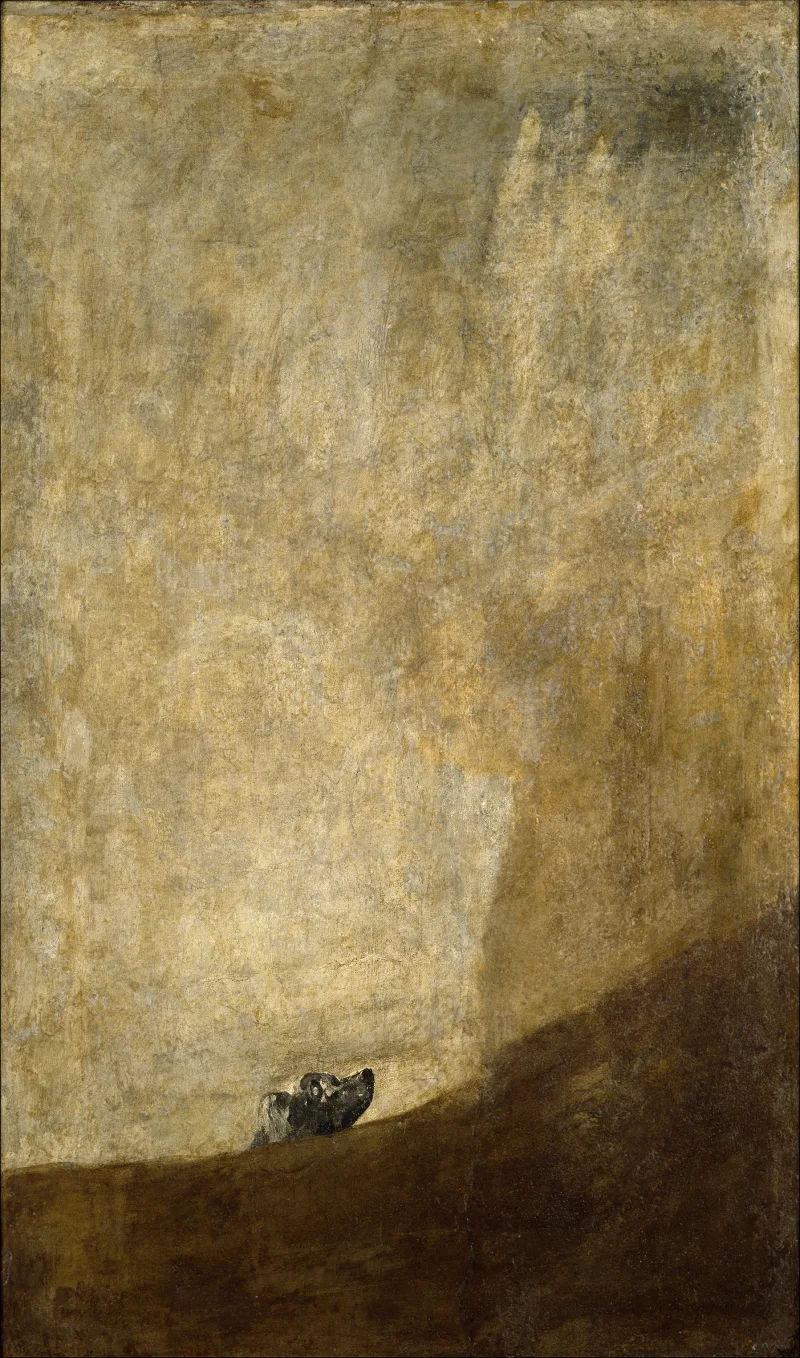
Cat. 10 / 30 · Victorian
Francisco Goya
The Dog
A small dog's head emerges from the lower edge of a vast field of yellow-brown. Above it: nothing. Below it: nothing. The painter has erased the world and left only an animal looking up out of it.
Painted on the wall of Goya's house outside Madrid as part of the late "Black Paintings" and later transferred to canvas, it is the most modern dog in nineteenth-century art — a dog of pure feeling, isolated against an emptiness the next century would learn to call existential.
Reproductions Find a print →
Cat. 12 / 30 · Victorian
Sir Edwin Landseer
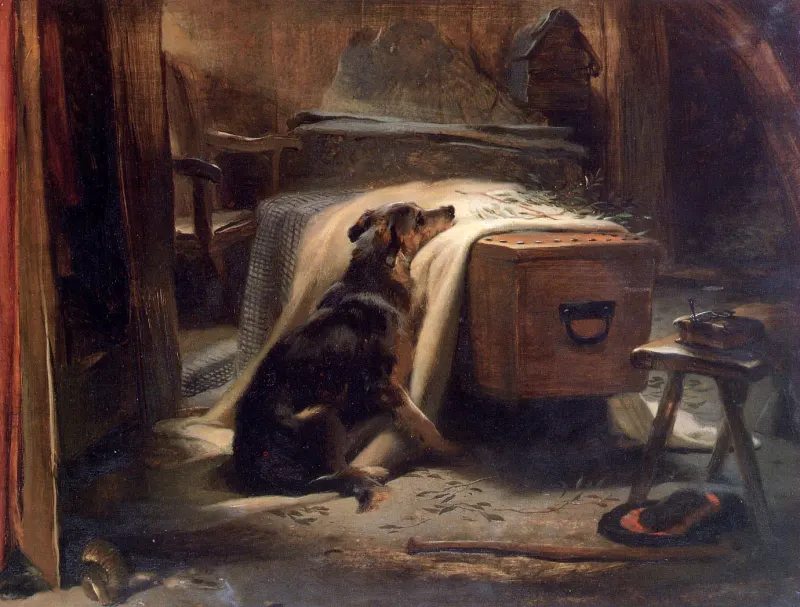
The Old Shepherd's Chief Mourner
A border collie rests its head on the closed coffin of a shepherd, alone in the room. The shepherd's hat lies on the floor; a pair of glasses sits on the lid of a bible.
Praised at its first exhibition by John Ruskin as a triumph of "true sympathy," the picture is also the painting most often cited when later critics argue that Victorian sentiment toward animals shaped the modern domestic dog itself.
Reproductions Find a print →
Read the full Sir Edwin Landseer biography 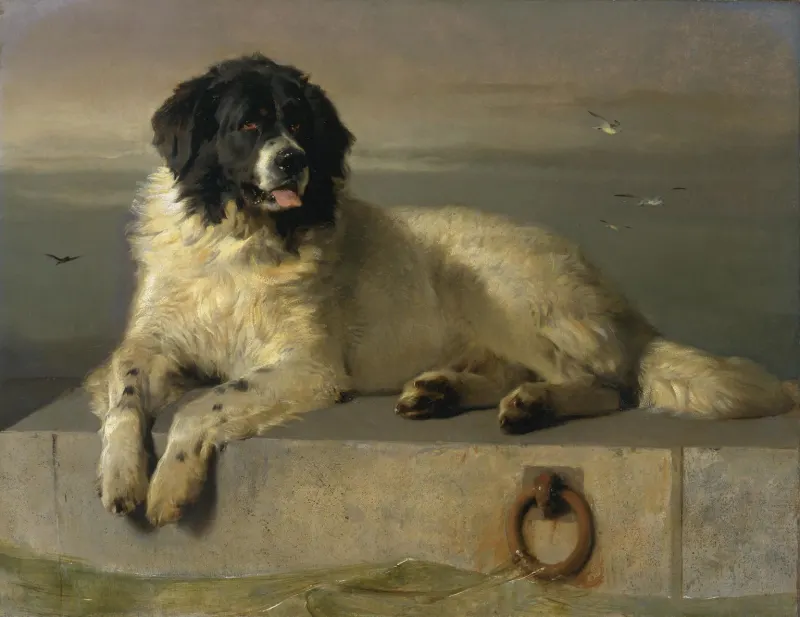
Cat. 13 / 30 · Victorian
Sir Edwin Landseer
A Distinguished Member of the Humane Society
A Newfoundland dog, painted nearly to life size, lies on a stone quay above dark water. The pose is the formal pose of a state portrait; the sitter is a working water-rescue dog.
The title is mock-ceremonial and entirely sincere. The Royal Humane Society had at the time taken to enrolling Newfoundlands as "distinguished members" for rescues from rivers — an honour Landseer extends here to oil-paint at full studio scale.
Reproductions Find a print →
Read the full Sir Edwin Landseer biography 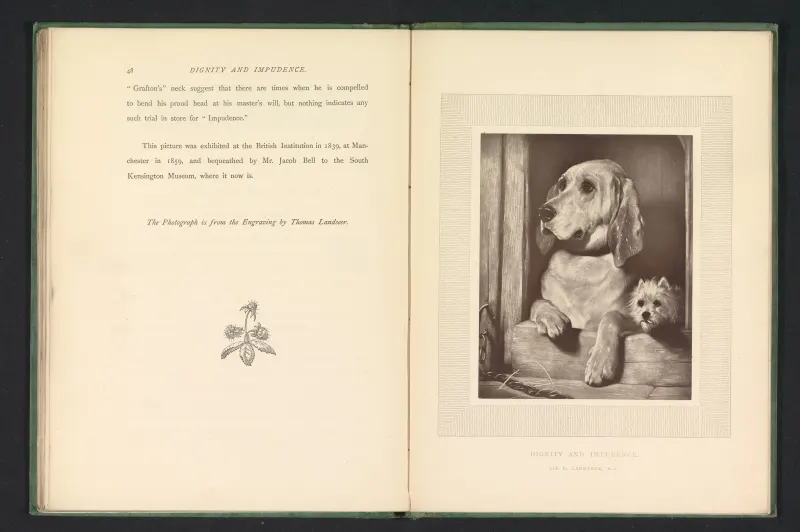
Cat. 14 / 30 · Victorian
Sir Edwin Landseer
Dignity and Impudence
A bloodhound named Grafton and a West Highland terrier named Scratch share a single kennel doorway, the first solemn and forward-facing, the second cocked curiously to one side.
The cleanest possible distillation of Landseer's gift for assigning human virtues to animals without overstepping into caricature. Reproduced more often, in more sizes, than any other Victorian dog painting.
Reproductions Find a print →
Read the full Sir Edwin Landseer biography 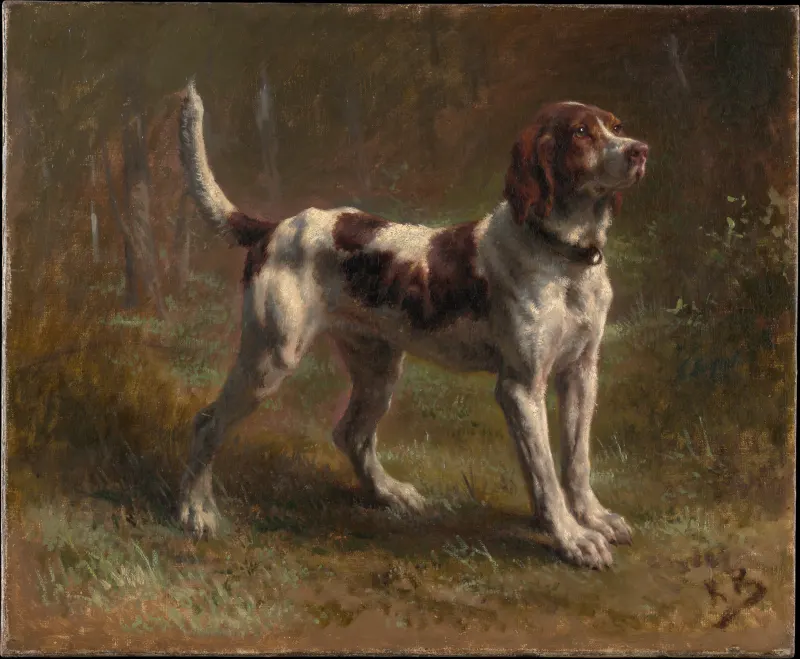
Cat. 15 / 30 · Victorian
Rosa Bonheur
A Limier Briquet Hound
Bonheur, by mid-career the most famous animal painter in Europe, paints a French hunting hound at attention against a low landscape. The dog's nose lifts toward something the painter has placed off-canvas.
The brushwork is firmer and the modeling drier than her cattle pictures — closer in handling to the studies of working horses that brought her the Legion of Honour. The dog is a worker; the painter treats it as one.
Reproductions Find a print →
Cat. 16 / 30 · Victorian
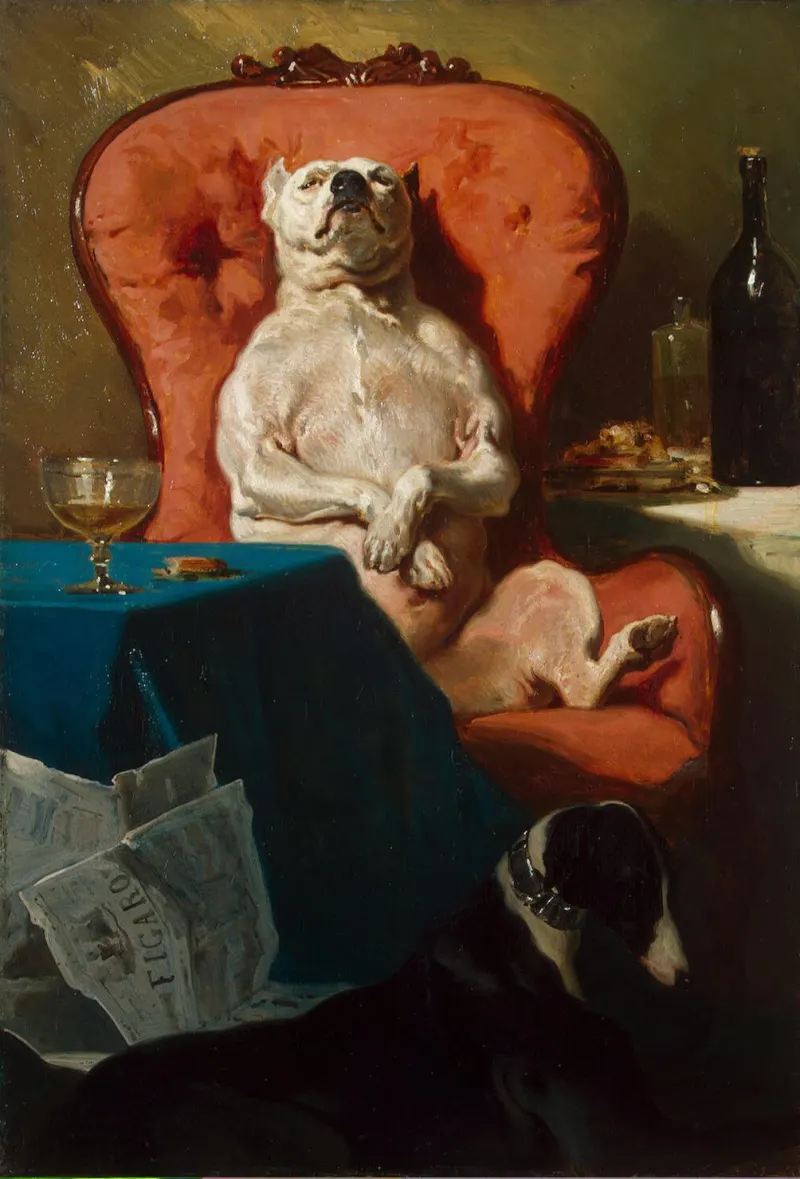
Alfred de Dreux
Pug in an Armchair
A pug sits squarely in a tall upholstered armchair, regarding the viewer at chair-height. The picture has the framing of a society portrait.
De Dreux, best known for the equestrian portraits commissioned by the French aristocracy, was equally trusted with the household dog — and the same painter who flattered the Duc de Morny's horses flattered, here, his pug.
Reproductions Find a print →
Cat. 17 / 30 · Victorian
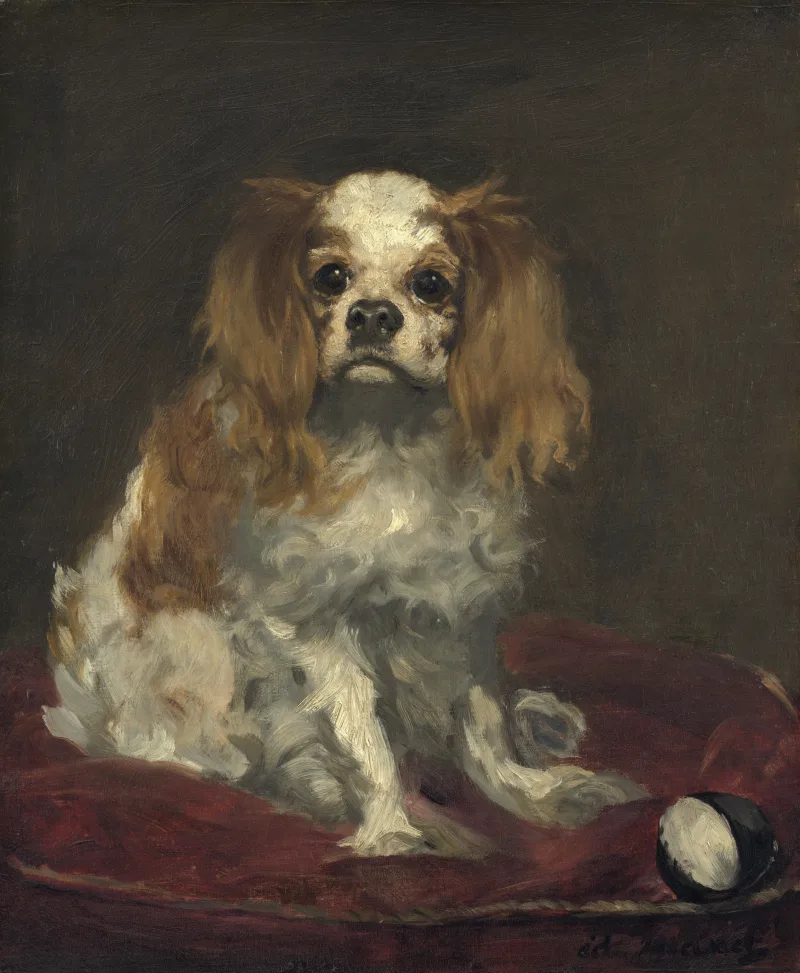
Édouard Manet
King Charles Spaniel
A small spaniel sits on a red plush cushion against a dark ground. The animal's long ears spread across the cushion; the painter has reduced the whole scene to three or four large patches of color.
Painted at a period when Manet was working in the most reduced palettes of his career, the picture treats the dog as a problem of color relations rather than of likeness. It is a portrait, but a portrait made in the language of still life.
Reproductions Find a print →
Cat. 22 / 30 · Victorian
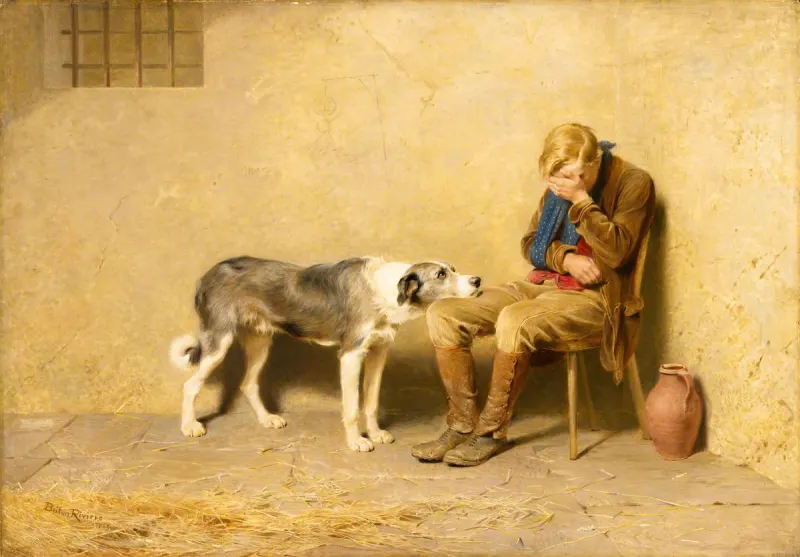
Briton Rivière
Fidelity
A man rests in a prison cell, head bowed against a stone wall; a dog at his side leans into his thigh, fully awake, watching the door.
Painted from a Wordsworth passage on a shepherd lost to a Lake District ravine, the picture became a touchstone of late-Victorian domestic morality. Rivière's skill is in making the dog's alertness, not the prisoner's exhaustion, the picture's subject.
Reproductions Find a print →
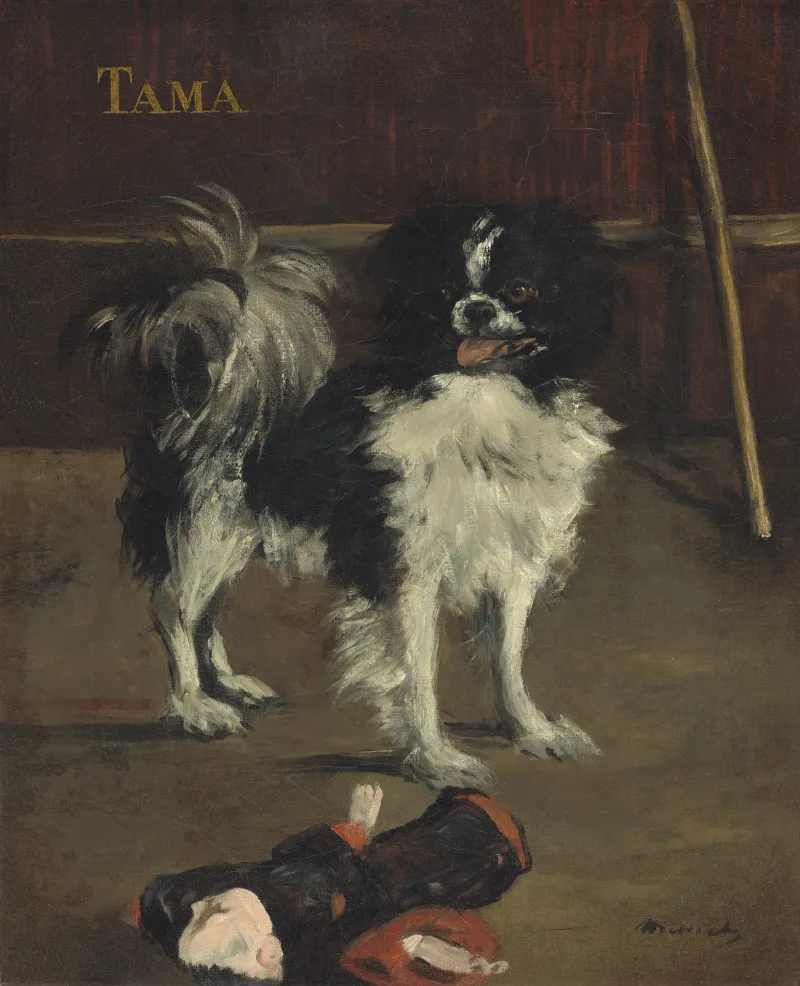
Cat. 18 / 30 · Victorian
Édouard Manet
Tama, the Japanese Dog
A small Japanese Chin stands at attention against a screen painted with chrysanthemums. The picture marks the moment Japonisme entered Parisian portraiture through the household pet rather than the woman of the house.
Tama belonged to the collector Henri Cernuschi, whose Asian-art collection later founded the Musée Cernuschi. The dog's likeness, painted near the height of Manet's mid-career, is among the few studio works he gave nearly without alteration to his subject.
Reproductions Find a print →
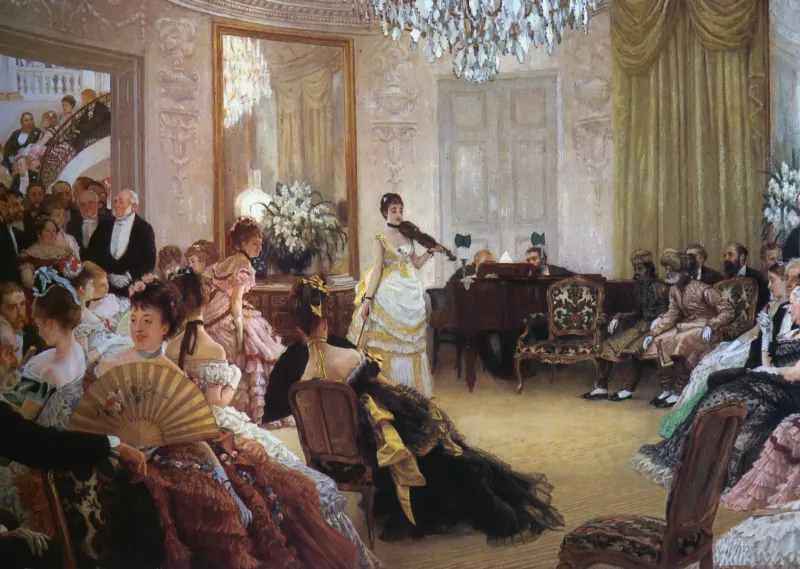
Cat. 19 / 30 · Victorian
James Tissot
Hush! (The Concert)
A musical evening in a London drawing-room. Two pugs work the foreground at the feet of the seated guests — one alert, one slumped over its forepaws — at the moment a violinist prepares to play.
The picture is an ensemble portrait of a society on the edge of a hush. The pugs do most of the work of pacing: the painter trusts the dogs, more than the humans, to register that a piece of music is about to begin.
Reproductions Find a print →
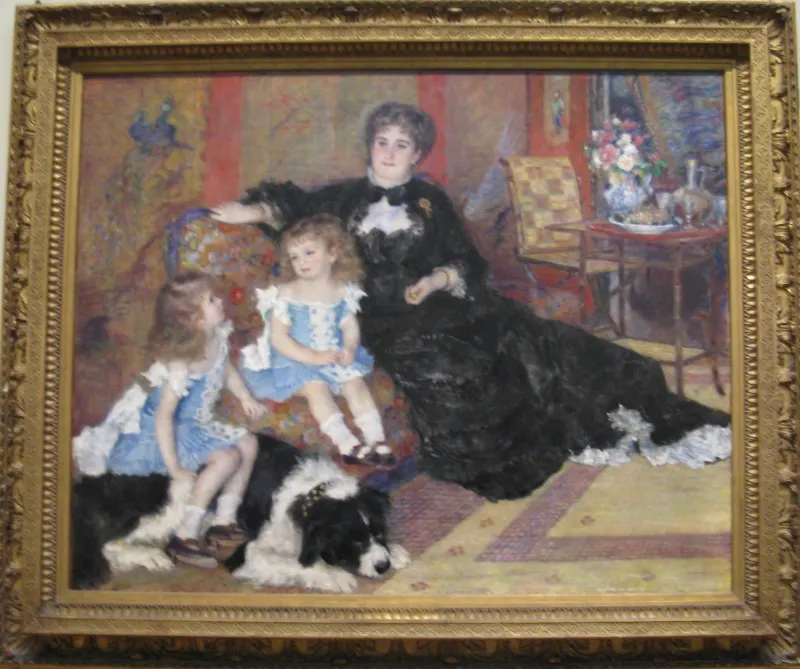
Cat. 20 / 30 · Victorian
Pierre-Auguste Renoir
Madame Charpentier and Her Children
A large household scene in which a Newfoundland-cross sprawls along a settee, the elder child seated on the dog's back as on a piece of furniture. The animal's weight stabilizes the lower third of the canvas.
The picture made Renoir's career at the Salon of 1879. The dog is more than a prop: it gives the picture the soft, near-tactile heaviness — the impression of a household at rest — that the painter would chase for decades after.
Reproductions Find a print →
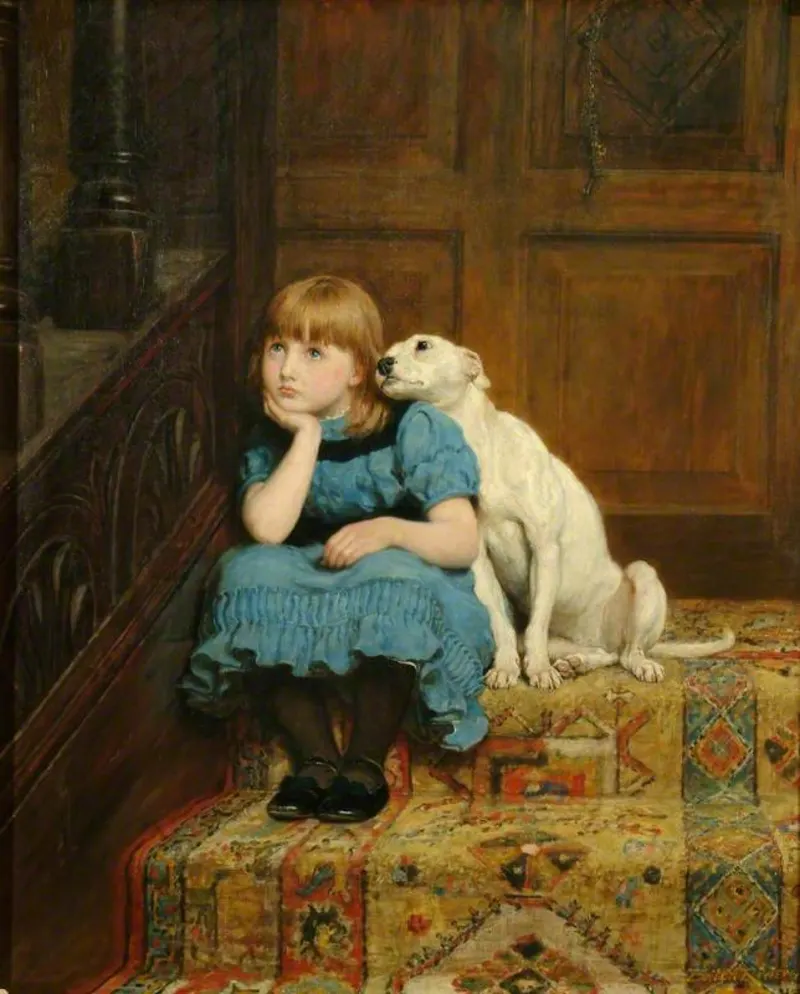
Cat. 21 / 30 · Victorian
Briton Rivière
Sympathy
A small child sits on a flight of stairs in disgrace. A Skye terrier sits one step below, head turned up, the whole body leaned toward the child.
The picture is among the most-reproduced Victorian images of the dog as confidant. Rivière, who painted dozens of dogs across his career, treats the terrier here not as a sentimental device but as a witness who happens to be made of fur.
Reproductions Find a print →
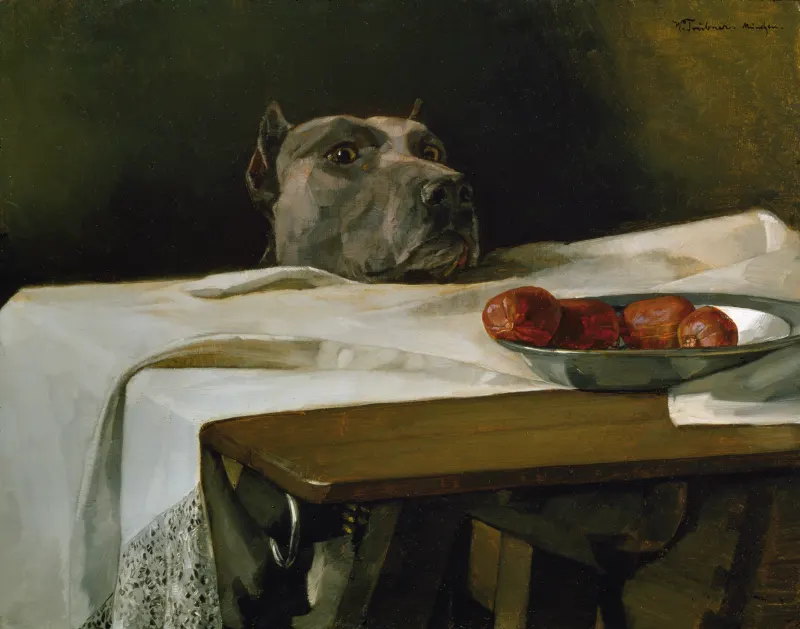
Cat. 24 / 30 · Modernist
Wilhelm Trübner
Caesar at the Rubicon
A short-haired bull terrier named Caesar stands at the edge of a shallow puddle, paw raised, hesitating before the water. The title is Trübner's deadpan joke: the dog's puddle is the Rubicon.
Trained in Munich under the Leibl Circle and committed to flat-painted realism, Trübner gives the animal his most exact studio attention. Every surface — the wet brick at the puddle's edge, the white-and-tan coat, the dog's hesitant forefoot — is painted as a problem of light rather than of feeling.
Reproductions Find a print →
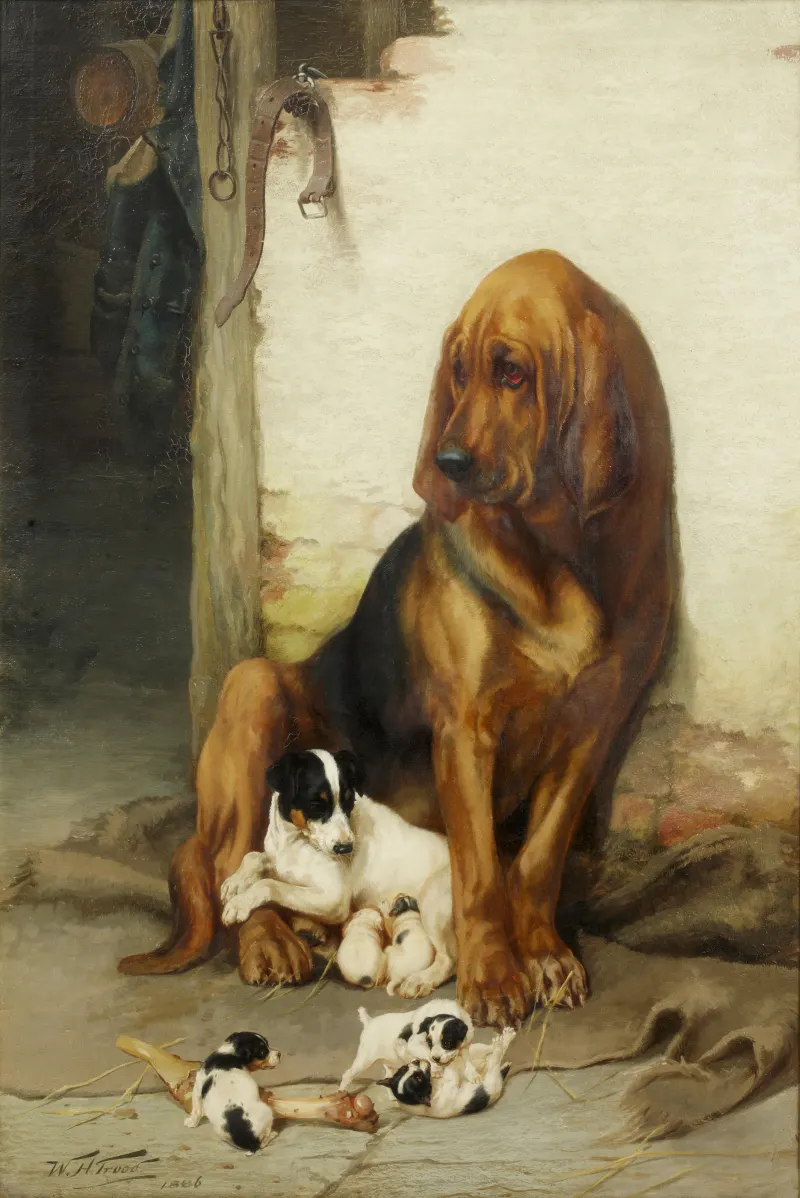
Cat. 11 / 30 · Victorian
William Henry Hamilton Trood
The Guardian
A single mastiff sits on a stone step, head turned in three-quarter profile, watching a doorway out of frame. Trood's habit was to place a working dog in the role of a sitter — and to paint that sitter with the seriousness of a society portrait.
A specialist dog painter throughout the 1870s and 1880s, Trood worked the late-Victorian sporting circuit of country-house commissions. The Guardian is among the most quoted of his canvases for the way it gives the household guard-dog a portrait-painter's attention without slipping into sentimentality.
Reproductions Find a print →

Cat. 30 / 30 · Modernist
John Emms
Hounds in a Kennel
A pack of foxhounds at rest on the straw of a hunt kennel, the bodies overlapping in the warm half-light. The picture is among the most representative of Emms's mature output.
Emms supplied the sporting estates of southern England with kennel portraits for thirty years. The Edwardian sporting trade kept him busier than any single dog painter since Stubbs; his hounds are, accordingly, the working dogs of the British countryside's last great hunting decades.
Reproductions Find a print →
Read the full John Emms biography 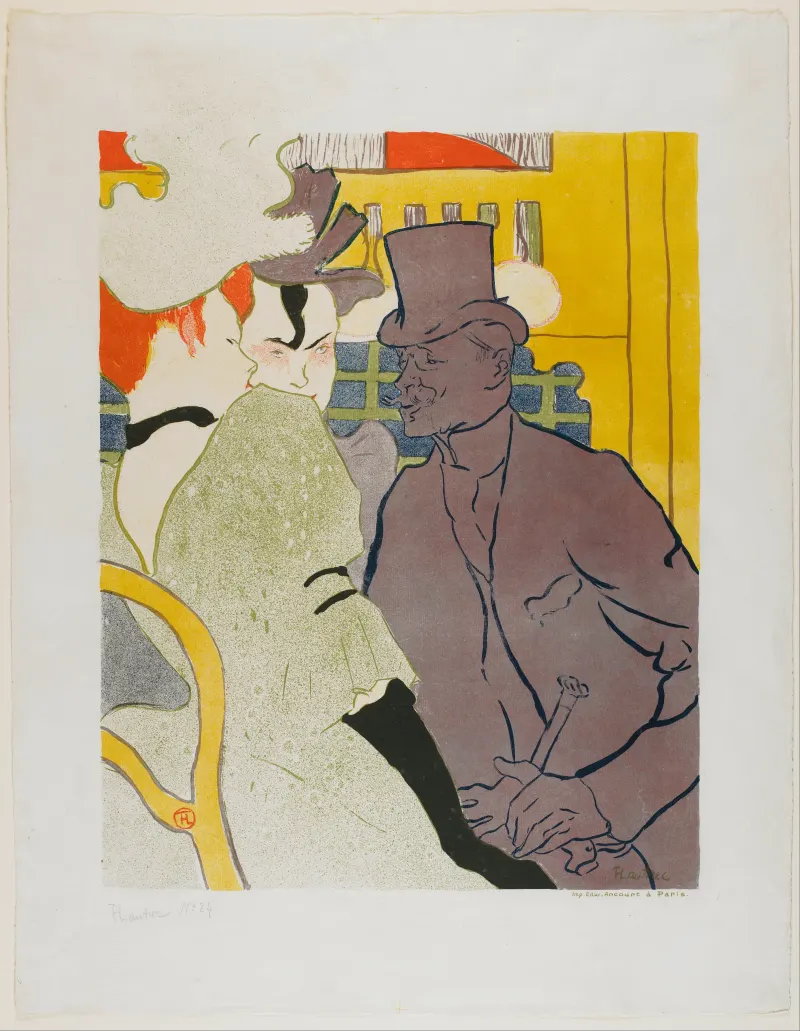
Cat. 28 / 30 · Modernist
Henri de Toulouse-Lautrec
The Englishman at the Moulin Rouge
A pug occupies the lower-left of the composition, foregrounded against the figures of the cabaret. The dog is the only sitter not in conversation; it looks directly back at the painter.
Toulouse-Lautrec drew animals throughout his life — his own bulldogs, dancers' lapdogs, street dogs in the rue des Moulins — but the pug at the Moulin Rouge is the one most quoted in later art-historical surveys.
Reproductions Find a print →
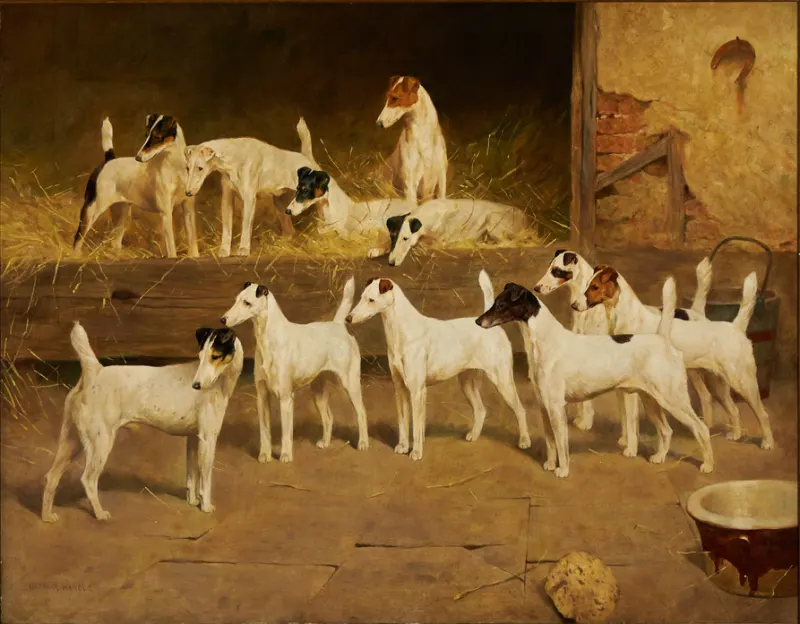
Cat. 25 / 30 · Modernist
Arthur Wardle
The Totteridge XI
Eleven champion fox terriers from the Totteridge kennels arranged across a country landscape, each animal painted from a separate sitting and composited into a single canvas.
Wardle was the leading British painter of show-dog likeness in the years around the turn of the century, and this group portrait — commissioned to commemorate a kennel's strain rather than a single dog — is the period's most ambitious example of the breed-portrait as type-study.
Reproductions Find a print →
Cat. 23 / 30 · Modernist
Carl Reichert
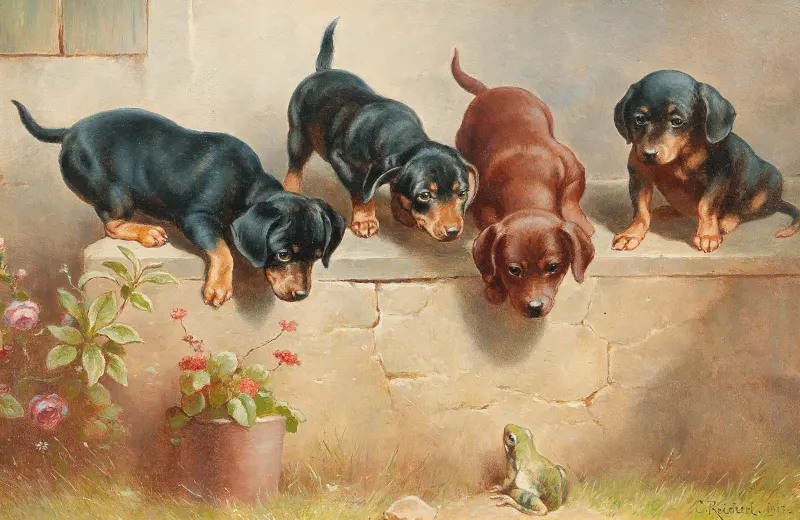
Curious Dachshund Puppies and a Frog
Three dachshund puppies investigate a small frog on a studio rug, the bodies overlapping into a single low-slung mass of dark-and-tan fur. Reichert's habit was to repeat the same breed across small, tightly composed groups — he understood the dog as a stage troupe.
The Graz-trained painter built a long career on these compositions, and the dachshund pictures in particular remain a fixed point of late-nineteenth-century commercial portraiture, sold in editions and reprints across central Europe.
Reproductions Find a print →
Cat. 27 / 30 · Modernist
Pierre Bonnard
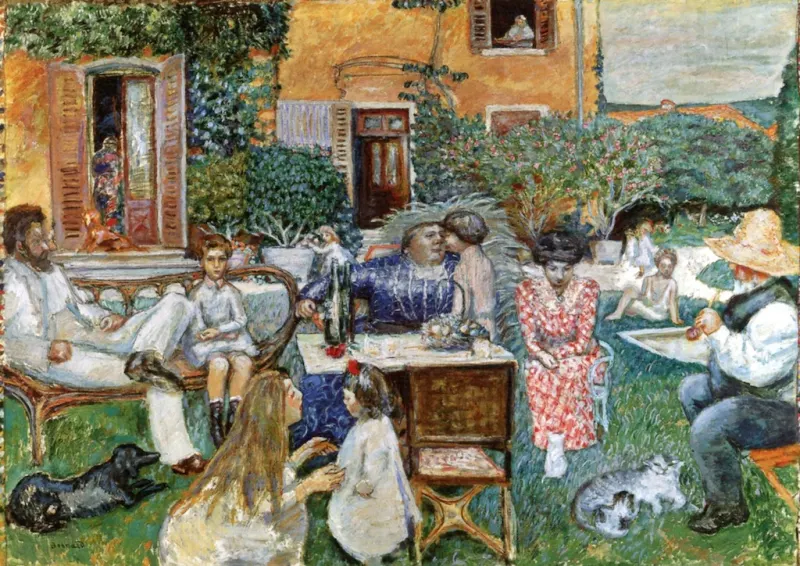
The Terrasse Family (L'Après-midi bourgeois)
A large garden afternoon, painter's family scattered across chairs and grass; two household dogs work the lower foreground, one stretched flat, one upright with its head turned toward the sitters.
Bonnard treats the dogs the way he treats the bourgeois furniture — as patches of warm color whose function is to settle the composition. Both animals are painted with the loose, near-pattern brushwork that defines his early Nabi period.
Reproductions Find a print →
Cat. 29 / 30 · Modernist
Cecil Aldin
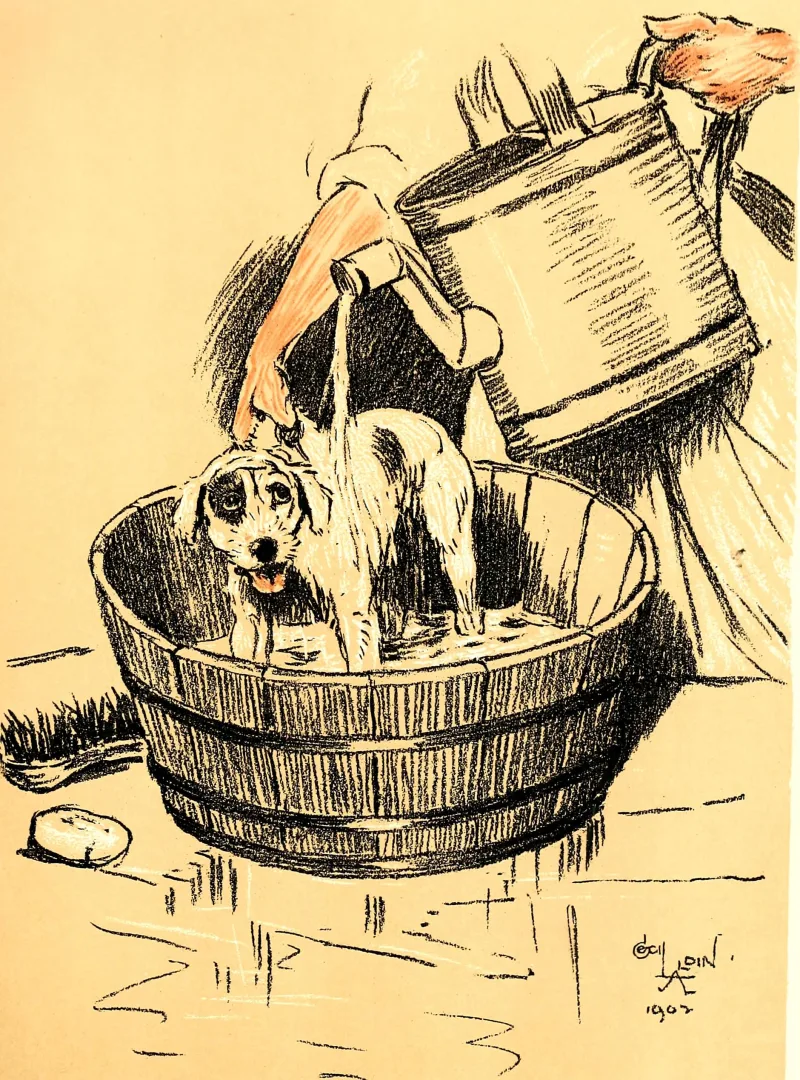
Plate from A Dog Day
A plate from Cecil Aldin's 1902 picture-book A Dog Day; or, The Angel in the House — the day-in-the-life of a bull terrier named Cracker. Aldin made the book's pictures in watercolour and saw them through to colour-plate reproduction himself.
Aldin's long career as a dog illustrator started here. The Dog Day plates carried the breed-portrait sensibility of Wardle and Earl into the home, and trained an Edwardian reading public to see the household pet at the same scale at which it would soon want the household pet painted.
Reproductions Find a print →
Cat. 26 / 30 · Modernist
Maud Earl
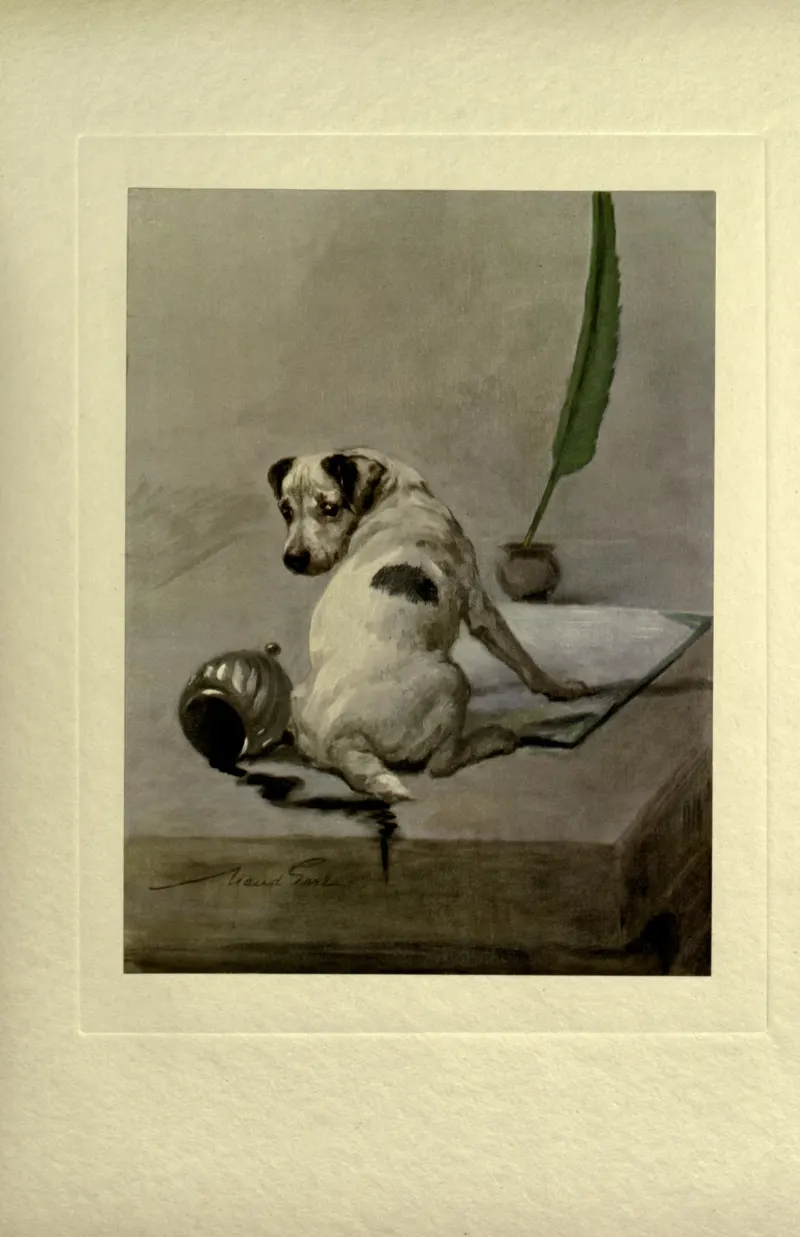
Plate from The Power of the Dog
A breed-portrait plate from Maud Earl's 1910 monograph The Power of the Dog — one of dozens she made for the book, each given the formal pose of a society portrait.
Earl, who painted Queen Victoria's and Edward VII's show dogs, treated the breed portrait as a separate genre with its own studio conventions. The plates in The Power of the Dog brought that genre to the wider book-collecting public; surviving copies remain the most accessible single body of her work.
Reproductions Find a print →
Read the full Maud Earl biography From the Pet Pic Portraits library
Commission a custom portrait of your dog.
A sister project to this catalog. Custom portraits of your dog rendered in the tradition.
Visit Pet Pic Portraits →
AI-rendered, reviewed by our team before delivery. Cross-link is editorial; no maker-voice claims.
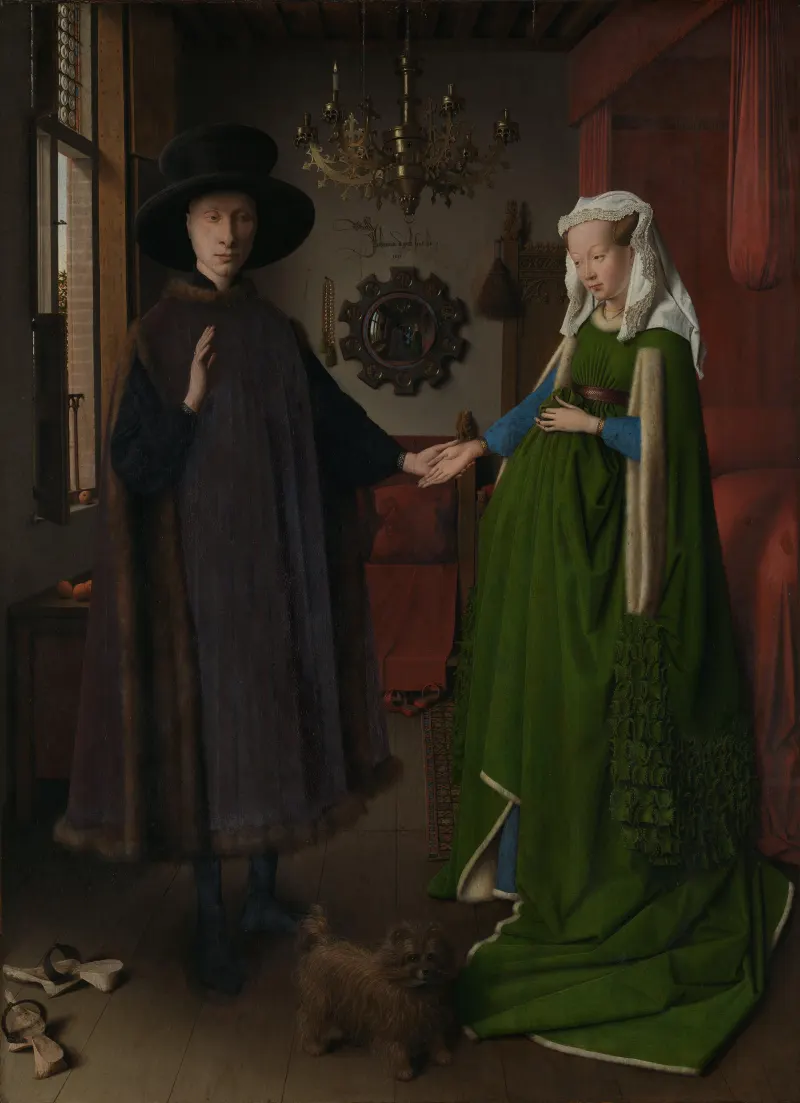
The small griffon terrier in the foreground of van Eyck's double portrait is among the first canonical dogs in Western painting. It stands forward of the couple's feet, paws planted, looking out of the picture toward the viewer.
Read by generations of art historians as an emblem of marital fidelity, the dog is also painted with documentary care — every whorl of its terrier coat picked out, the wet shine on its eye treated with the same patience van Eyck reserves for the mirror behind the figures.